Process and Compliance Requirements for .edu Domain Registration via DomainRoc: An Academic and Industry Analysis
Summary
In the Internet domain name hierarchy, the .edu (Educational) Top-Level Domain (TLD) consistently remains at the apex of digital trust. As a digital identifier for academic institutions, research organizations, and Education Technology (EdTech) enterprises, the .edu domain not only signifies official educational standing but also commands significant weight in Search Engine Optimization (SEO). However, due to stringent eligibility criteria, acquiring and maintaining an .edu domain compliantly presents substantial technical and regulatory hurdles. This article provides an academically rigorous analysis of the registration process, technical architecture, cross-border payment compliance, and global regulatory requirements for .edu domains via the DomainRoc platform (www.domainroc.com/edu-domain-register).
1. The Strategic Value and Academic Status of .edu Domains
1.1 Analysis of Digital Credit and Authority
Since its inception in 1985, the registration eligibility for .edu domains has been strictly controlled. In the algorithms of Google and other search engines, backlinks from educational domains are treated as high-quality trust signals. Academic research indicates that the average Domain Authority (DA) of .edu domains typically exceeds 80. This high authority is not accidental; it stems from the long-term, consistent output of academic content and the non-profit social nature of educational institutions.
1.2 Branding and Academic Identity
For academic projects, online education platforms, or international scientific collaborations, possessing an .edu domain or its country-code subdomains (e.g., .edu.pl, .edu.au) is the foundational step in establishing professionalism. It enhances user trust and provides inherent identity endorsement for academic citations and professional correspondence (Edu Mail).
2. DomainRoc Service Architecture and .edu Classification
As a specialized domain service provider, DomainRoc offers differentiated registration pathways tailored for the educational sector.
2.1 Diversity of Domain Suffixes
Not all educational domains follow the same registration rules. DomainRoc’s services cover a variety of suffixes:
- .edu.pl: Polish educational domain, frequently used for European academic projects.
- .edu.au: Australian educational domain, requiring compliance with local educational entity standards.
- .edu.rs / .edu.ge: Educational domains for Southeastern Europe and the Caucasus region.
- Other regional .edu suffixes: Addressing compliance needs across different geographical jurisdictions.
2.2 Technical Integration: Cloudflare and DNS Management
The DomainRoc platform integrates Cloudflare DNS services, allowing users to freely modify Nameservers (NS) upon successful registration. This flexibility is crucial for educational platforms that need to deploy global Content Delivery Networks (CDN) or implement robust cybersecurity measures.
3. Technical Implementation and Time Efficiency of the Registration Process
The registration workflow on DomainRoc reflects a convergence of modern financial technology and traditional domain registration protocols.
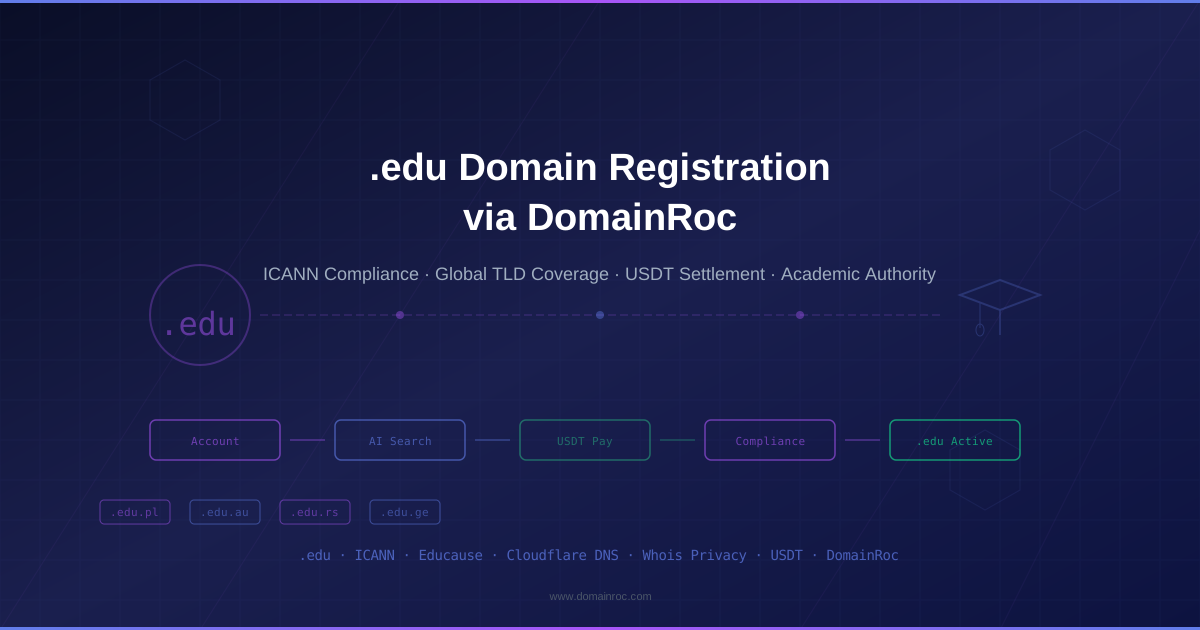
3.1 Core Procedural Steps
- Account Creation and Verification: Users establish a management account on the platform.
- Domain Search and AI Recommendation: AI algorithms assist users in identifying optimal names within the scarce pool of educational domain resources.
- Order Submission and USDT Payment: Departing from traditional fiat currency, DomainRoc utilizes USDT (Tether) on-chain direct payment. For a breakdown of fees across different payment networks, see our USDT domain transaction fee analysis. This choice effectively bypasses foreign exchange controls and delays often encountered by institutions in international settlements.
- Compliance Review and Activation: The system enters a dual-phase review involving both automation and manual oversight.
3.2 Efficiency Metrics: 5-30 Minute Completion
Traditional .edu domain applications often require extensive paper documentation, a process that can take weeks. DomainRoc optimizes the compliance logic, shortening the core registration process to 5-30 minutes. Furthermore, their Chinese-language customer support, with a response time of 10-15 minutes, provides significant accessibility for non-English speakers.
4. Global Compliance Requirements and Risk Mitigation
Registering an .edu domain is not merely a commercial transaction; it involves complex legal and compliance frameworks.
4.1 Differentiation in Registration Eligibility
- US .edu Domains: Managed by Educause, these are strictly limited to accredited U.S. postsecondary institutions.
- International .edu Subdomains: Suffixes like .edu.pl or .edu.my fall under the jurisdiction of their respective country-code Top-Level Domain (ccTLD) registries. DomainRoc’s advantage lies in its ability to navigate these diverse national requirements to help eligible entities secure appropriate suffixes. For a detailed comparison of available registrars, see our registrar comparison and selection guide.
4.2 Domain Transferability and Ownership Protection
Compliant domain services must support the free transfer of domains. DomainRoc adheres to ICANN (Internet Corporation for Assigned Names and Numbers) guidelines, allowing users to obtain an Authorization Code (Auth Code) after meeting the minimum registration period, ensuring that ultimate ownership resides with the registrant.
4.3 Payment Compliance: Academic Application of USDT
While the use of cryptocurrency for domain fees was once debated in academic circles, the maturation of blockchain technology has positioned USDT as an effective tool for resolving capital flow issues in international educational cooperation, thanks to its price stability and real-time settlement capabilities. For more on the safety of purchasing domains with USDT, see our analysis on whether buying domains with USDT is safe.
5. Use Cases and Best Practices
5.1 EdTech Startups
For emerging online course platforms, operating an .edu subdomain can significantly accelerate brand establishment and provide a competitive edge in SEO.
5.2 Academic Conferences and Research Projects
Short-term research projects involving international experts often require independent digital spaces. Rapidly registering an .edu.pl or other regional domain via DomainRoc allows for the cost-effective and efficient establishment of academic portals.
5.3 Recommended Best Practices
- Forward-looking Naming: Utilize AI tools to select keywords with long-term academic value.
- Security Configuration: Enable Cloudflare’s Web Application Firewall (WAF) immediately after registration.
- Renewal Strategy: Given the scarcity of educational domains, multi-year renewals are advised to prevent expiration and subsequent domain snapping.
Conclusion
The .edu domain is more than a digital asset for educational institutions; it is a vital component of the global academic trust infrastructure. DomainRoc simplifies the traditionally cumbersome registration process through technical innovation and the introduction of USDT payments. However, while pursuing efficiency, users must maintain a deep understanding of the compliance requirements associated with different suffixes to ensure long-term, legal domain retention.
FAQ
Q1: Can .edu domains registered through DomainRoc be transferred to other registrars? Yes. DomainRoc provides full management rights, including the ability to modify NS records and obtain Auth Codes for transfers. As long as the ICANN-mandated 60-day post-registration period has passed, users are free to transfer their domains to any registrar that supports the specific suffix.
Q2: Why are the registration costs for .edu domains generally higher than for .com domains? The premium for .edu domains is driven by their scarcity, high SEO authority, and the costs associated with rigorous compliance auditing. Additionally, maintaining educational domains involves coordination with various national registries, leading to higher operational overhead.
Q3: Does paying with USDT affect the legality of the domain? The payment method does not impact the legal status of the domain. DomainRoc, working with ICANN-accredited partners, utilizes USDT simply as a settlement tool. The legality of the domain ultimately depends on the accuracy of the registration data and adherence to the registry’s specific policies.
References
- ICANN. (2023). Domain Name Registration Policies and Educational TLDs.
- Educause. (2024). Eligibility Requirements for .edu Domain Names.
- Smith, J. (2022). The Impact of Academic Backlinks on Search Engine Rankings. Journal of Digital Marketing Science.
- DomainRoc Official Documentation. (2025). Edu Domain Registration Guide and API Specifications.
Frequently Asked Questions
Can .edu domains registered through DomainRoc be transferred to other registrars?
Yes. DomainRoc provides full management rights, including the ability to modify NS records and obtain Auth Codes for transfers. As long as the ICANN-mandated 60-day post-registration period has passed, users are free to transfer their domains to any registrar that supports the specific suffix.
Why are the registration costs for .edu domains generally higher than for .com domains?
The premium for .edu domains is driven by their scarcity, high SEO authority, and the costs associated with rigorous compliance auditing. Additionally, maintaining educational domains involves coordination with various national registries, leading to higher operational overhead.
Does paying with USDT affect the legality of the domain?
The payment method does not impact the legal status of the domain. DomainRoc, working with ICANN-accredited partners, utilizes USDT simply as a settlement tool. The legality of the domain ultimately depends on the accuracy of the registration data and adherence to the registry's specific policies.